
 Running is one of the most visible and popular forms of exercise across the UK, particularly in cities such as London. Early in the morning and late in the evening, it is common to see runners moving through parks, along the Thames, or through busy streets before and after the working day. Charity races regularly fill city streets, major marathons sell out months in advance, and many workplaces now organise group runs as social or team-building events.
For many people, running begins with positive intentions. It offers a simple way to improve cardiovascular health, manage stress and work towards personal goals. Completing a race, particularly for the first time, can be deeply rewarding and often creates a strong sense of achievement, connection and purpose.
It is also easy to understand why running is so appealing. Compared with many other sports, it appears simple. There is no need for expensive equipment or specialised facilities, and the barrier to entry is relatively low. A pair of trainers and an open pavement can feel like all that is needed.
From a clinical perspective, however, the picture is often more complicated. Healthcare professionals who regularly treat musculoskeletal injuries frequently see the consequences of enthusiastic training without the preparation needed to support the body through repetitive impact.
Running itself is not the problem. More often, the issue lies in how people approach it.
When done well, running can be an excellent contributor to long-term health. When approached without enough preparation, progression or understanding, it can become a common source of overuse injury.
The Benefits of Running
Before discussing the challenges associated with running, it is important to recognise its genuine benefits. Running remains one of the most accessible and effective ways to improve overall fitness.
Regular running can contribute to improved cardiovascular health, increased aerobic capacity, better metabolic function, reduced stress, improved mental wellbeing, and a greater sense of achievement and resilience.
Many runners also value the social side of the activity. Community runs and charity events often provide encouragement, accountability and a strong sense of shared purpose.
These benefits are best realised when running is part of a training approach that respects how the body adapts to load.
The Reality: Running Injuries Are Common
Running is a repetitive, high-impact activity. With each stride, the body absorbs forces several times greater than body weight through the feet, ankles, knees, hips and spine.
The body is remarkably adaptable, but tissues such as tendons, bones and joint structures need time to develop the capacity to tolerate these loads.
Research consistently shows that a significant proportion of recreational runners experience injury each year, particularly during the early stages of training or when mileage increases too quickly.
Common running injuries include patellofemoral pain, often called runner’s knee, iliotibial band irritation, shin splints, Achilles tendon irritation, plantar fascia pain, and stress fractures in the lower leg, foot or, more occasionally, the back.
These injuries rarely appear out of nowhere. More often, they develop gradually as small amounts of mechanical stress accumulate faster than the body can adapt.
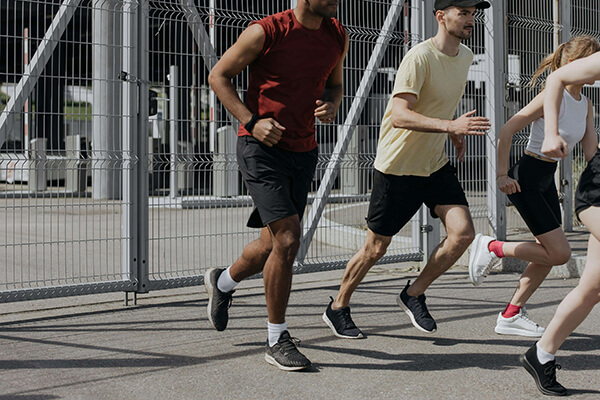
Why So Many Runners Develop Injuries
One of the most common misconceptions about running is that it is simply a cardiovascular activity. Many people assume that if they can walk, they can quickly progress to running longer distances.
In reality, running places significant mechanical demands on the body. Muscles, tendons and bones all need to adapt to repetitive loading. When training progresses faster than these tissues can tolerate, injury risk rises.
Several factors commonly contribute to problems. These include rapid increases in running distance or frequency, poor movement mechanics, insufficient strength in supporting muscles, limited recovery between sessions, and attempts to manage symptoms with passive solutions rather than addressing the underlying cause.
When pain begins to appear, many runners look for quick fixes. Knee supports, new trainers, orthotic inserts or cold plunges may reduce discomfort temporarily. These approaches can occasionally help, but they rarely resolve the root cause if the underlying movement patterns and loading strategies remain unchanged.
Running successfully requires more than endurance. It also requires coordination, strength and efficient movement.
Running Is a Whole-Body Movement
Another misunderstanding is that running is mainly driven by the legs. In truth, efficient running depends on coordinated movement throughout the entire body.
Human locomotion follows a cross-pattern system. As the right leg moves forwards, the left arm naturally swings forwards. When the left leg advances, the right arm follows. This cross-body pattern allows forces generated by the legs to be balanced and stabilised through the torso.
The shoulders, trunk and hips therefore work together as an integrated system.
The hips generate much of the propulsive force during running, particularly through the gluteal muscles. However, these muscles depend on trunk stability and coordinated upper-body movement to function effectively.
When this coordination is lacking, several problems can arise. Excessive rotation through the lower back may develop, the knees may experience greater stress, and the running stride may become less efficient.
Poor shoulder control can also affect lower-body mechanics. Excessive arm swinging or tension through the upper body often leads to unnecessary rotation through the torso, which can then alter how force travels through the pelvis and legs.
Developing good shoulder-to-hip coordination is therefore an important part of sustainable running. Movement therapy that reinforces cross-pattern movement and trunk stability can help restore balance across the system.
Breathing: The Often Overlooked Foundation of Running
Among all the elements that contribute to effective running, breathing is perhaps the most overlooked.
Many people think of breathing purely as a way of delivering oxygen to working muscles. While oxygen delivery is certainly important, breathing also plays a major role in posture, stability and pelvic health.
The diaphragm, the primary muscle involved in breathing, forms part of the body’s deep stabilising system. It works in coordination with the abdominal muscles, spinal stabilisers and the pelvic floor to regulate pressure within the abdominal cavity. This pressure helps support the spine and pelvis during movement.
When breathing becomes shallow or restricted, this stabilising system may become less effective.
Many runners unconsciously adopt upper-chest-dominant breathing patterns, especially under physical or psychological stress. During running, this may lead to irregular breathing rhythms, increased tension in the shoulders and reduced stability through the trunk.
In some individuals, particularly women, poor breathing coordination combined with repeated impact may also contribute to pelvic floor strain during exercise.
A more efficient breathing pattern can make a significant difference. Effective breathing during running usually involves allowing the diaphragm to move freely while maintaining a relaxed ribcage and upper body. Rather than forcing large breaths, the aim is to establish a steady rhythm that works naturally with the stride.
When breathing, posture and movement are properly coordinated, running often feels smoother, more controlled and less physically demanding.
Footwear, Orthotics and Passive Solutions
 Modern running culture places considerable emphasis on footwear. Shoes can certainly influence comfort and cushioning, but they do not fundamentally change how the body moves.
A new pair of trainers cannot correct poor hip control or inefficient movement patterns. Similarly, orthotics may provide support in certain situations, but they are most effective when used alongside appropriate assessment and rehabilitation.
Relying too heavily on passive solutions can sometimes mask symptoms without addressing the underlying mechanical problem.
In most cases, improving the body’s ability to manage load is far more effective than relying on external support alone.
Recovery and Training Progression
Another common issue among recreational runners is inadequate recovery.
Training adaptations occur during rest, when tissues repair and strengthen in response to the stresses placed upon them. Without sufficient recovery time, the cumulative load on tissues can exceed their ability to adapt.
Sustainable training therefore depends on a few key principles: gradual progression of distance and intensity, movement and resistance training to support running mechanics, adequate sleep and recovery, and attention to early warning signs of discomfort.
Ignoring pain or repeatedly pushing through symptoms often leads to longer recovery periods later.
When Runners Should Seek Professional Help
Many running-related aches settle naturally with rest and gradual adjustment of training. However, there are times when professional assessment can be particularly helpful.
Persistent discomfort often suggests that the body is struggling to manage the mechanical stresses being placed upon it. In these situations, simply resting for a short period and then returning to the same training pattern often leads to the same problem recurring.
It is worth seeking professional guidance if pain persists for more than a few weeks despite reducing training, if discomfort appears early in a run and worsens with continued activity, if pain interferes with everyday movements such as walking or climbing stairs, if symptoms repeatedly return after resuming training, or if pelvic discomfort or pelvic floor symptoms develop during running.
Assessment in these situations often focuses on how the body moves as a system. Subtle imbalances in joint mobility, muscle coordination or breathing mechanics can affect how forces are transmitted through the body during running.
Addressing these factors can help reduce unnecessary strain on vulnerable areas and allow runners to return to training with greater confidence.
For many individuals, the goal is not simply to treat an injury but to understand how their body can run more efficiently and sustainably over time. With the right guidance, running can remain an enjoyable and beneficial activity rather than a recurring source of frustration.
Supporting Runners Through Integrative Chiropractic Care
From an integrative chiropractic perspective, the aim is not to discourage running but to help people develop the physical capacity to run sustainably.
Effective care often begins with understanding how the body moves. Assessing joint mobility, muscle balance and coordination patterns can reveal why certain structures are becoming overloaded.
Treatment may include manual therapy, movement education and targeted strengthening strategies designed to restore efficient mechanics.
A comprehensive approach may involve improving joint mobility and movement patterns, strengthening the hips, trunk and stabilising muscles, restoring natural breathing coordination, and guiding a gradual return to running following injury.
Running for the Long Term
Running has the potential to be a lifelong activity that supports both physical and mental health. Its benefits, however, are best realised when training is approached with patience, structure and understanding.
The goal should not simply be to increase mileage as quickly as possible or to push through discomfort in pursuit of a race result. Sustainable running is built on strong foundations: coordinated movement, effective breathing, progressive training and adequate recovery.
When these principles are respected, running becomes far more than a test of endurance. It becomes a form of movement that supports health, resilience and enjoyment for many years to come.
When to Consider an Assessment
If running-related pain keeps returning, or if you feel that your body is not tolerating training as it should, a more detailed assessment may help identify why. Looking at movement patterns, breathing mechanics, mobility and strength can often provide useful direction for recovery and longer-term training.
The aim is not just to get you out of pain, but to help you run well for the long term.