
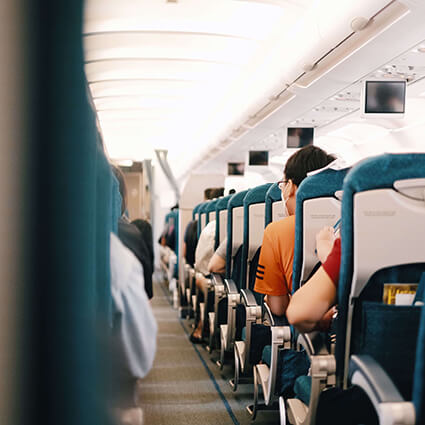
 For many of us, flying is simply the bit between leaving home and arriving somewhere new. We think about passports, luggage, airport queues and whether we remembered to download something to watch. What we perhaps think about less is just how unusual the experience is for the body.
Within a few hours, we can go from walking around at ground level to sitting almost motionless in a pressurised cabin several miles above the earth, breathing very dry air, eating at an unusual time and perhaps crossing several time zones in the process.
For most healthy people, flying is very safe and the body adapts remarkably well. But that does not mean nothing is happening.
From our circulation and digestive system to our joints, skin, sleep and even the way food tastes, air travel temporarily changes the environment in which the body has to function.
So what actually happens to your body when you fly?
It starts with the cabin itself
Although an aircraft may be cruising at around 35,000 feet, the cabin is pressurised. It is not, however, pressurised to the equivalent of being at sea level.
On a typical commercial flight, cabin pressure may be equivalent to being approximately 6,000-8,000 feet above sea level. This means there is less atmospheric pressure and therefore a lower partial pressure of oxygen than we experience on the ground.
For most healthy people, this causes no significant problem. The body simply adapts. However, people with certain heart, lung, blood or circulatory conditions may be more sensitive to the change and should seek appropriate medical advice before flying when necessary.
The reduction in pressure also explains another familiar experience: your ears popping.
As the aircraft climbs and descends, pressure changes affect air-filled spaces within the body, particularly the middle ears and sinuses. If you are congested with a cold, allergy or sinus problem, equalising that pressure can become more difficult, which is why descent can sometimes be surprisingly uncomfortable.
The same principle applies further down the body.
Gas within the digestive tract expands as cabin pressure falls. Research suggests that gas volume can increase by around 30% at typical cabin pressures. So if you have ever wondered why you feel unusually bloated on a flight, it isn’t necessarily just the airline meal.
Your body becomes much less mobile
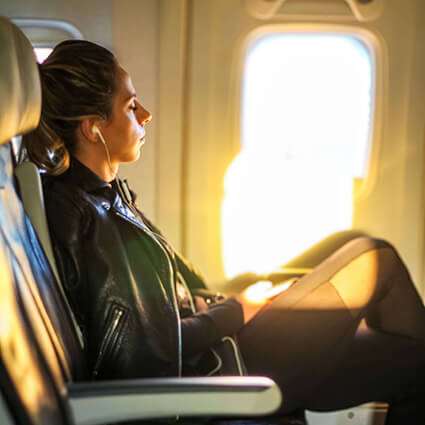 Perhaps the biggest physical change during a flight has nothing to do with altitude at all.
We sit.
And we sit for a very long time.
The human body is designed to move regularly. Walking, changing position and using the muscles of the legs all help maintain circulation and distribute mechanical load throughout the body.
An aircraft seat does almost the opposite.
The hips remain flexed. The knees remain bent. The ankles barely move. The pelvis may gradually roll backwards, particularly as we become tired, and the upper body often follows. Add a laptop, phone, book or several hours of films and the head may spend a considerable amount of time sitting forward of the shoulders.
None of these positions is inherently “bad”. The problem is usually duration rather than posture itself.
A position that feels perfectly comfortable for ten minutes can feel very different after three or four hours without meaningful movement.
This can contribute to stiffness through the lower back, hips, upper back and neck. Existing musculoskeletal symptoms may also become more noticeable, particularly if someone already has reduced spinal or hip mobility.
Then there is sleep.
Trying to sleep upright often leads us into some wonderfully inventive positions that we would never deliberately adopt at home. The head drops to one side, the lower back collapses into the seat and we may remain there until turbulence, the drinks trolley or our neighbour wakes us.
It is therefore hardly surprising that some people step off a long flight feeling as though their body has aged several years overnight.
Your circulation changes too
The muscles of the lower legs play an important role in helping blood return towards the heart.
When we walk, the calf muscles repeatedly contract and relax, effectively assisting venous circulation. During prolonged sitting, this muscular pump becomes much less active.
Fluid can therefore accumulate in the lower legs and feet, which is one reason shoes sometimes feel tighter at the end of a long flight.
More importantly, prolonged immobility is a recognised risk factor for deep vein thrombosis (DVT), where a blood clot develops in a deep vein, usually in the leg.
For most healthy travellers the absolute risk remains low, but risk increases with factors including previous DVT or pulmonary embolism, recent surgery, pregnancy, certain medical conditions, some medications and prolonged immobility.
This is why movement on a long flight matters for more than simply preventing a stiff back.
When it is safe to do so, getting up periodically, walking around the cabin and regularly moving the ankles and calf muscles can all help maintain movement and circulation.
Then we ask our back and shoulders to lift the luggage
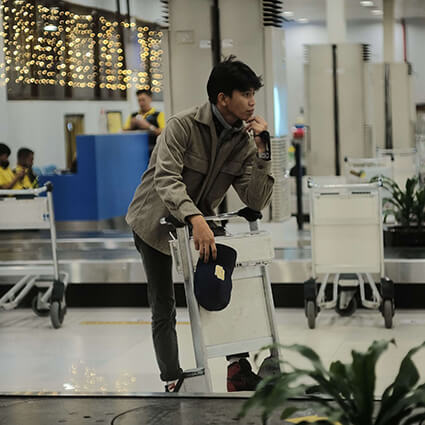 Interestingly, some of the greatest musculoskeletal demands of flying happen before we have even sat down.
There is the suitcase lifted out of the car, pulled from a train, taken onto an escalator and dragged through the airport.
Then comes the cabin bag.
Lifting a relatively heavy bag from below waist height, often while twisting in a narrow aisle, and then placing it into an overhead locker requires considerably more shoulder, spinal and trunk movement than we might realise.
The risk of irritating something is likely to be greater if the bag is heavier than expected or if we try to lift it at arm’s length.
If possible, bring the bag close to your body before lifting it, use both hands and turn your whole body rather than twisting through the spine while holding the load. There is also nothing wrong with asking for help.
Flying can dry your skin, eyes, nose and throat
Aircraft cabins are exceptionally dry environments. Relative humidity is commonly around 10-20%, considerably lower than most indoor environments.
The effect is often obvious.
Your lips feel dry. Your skin feels tight. Your eyes may become irritated, particularly if you wear contact lenses. Your nose and throat can also feel noticeably dry.
This happens because moisture is continually being lost to the surrounding dry air.
Drinking water is sensible, particularly on longer journeys, although it is worth separating two different ideas that are often confused. Cabin air can make the skin, eyes and mucous membranes feel dry, but that does not automatically mean every passenger is becoming dangerously dehydrated.
Alcohol can complicate matters. Aside from its other effects, drinking heavily on a flight can interfere with sleep quality and make the fatigue associated with travel and jet lag feel worse.
And what about UV exposure by the window?
There is another aspect of the cabin environment that receives considerably less attention: sunlight.
Ultraviolet radiation becomes more intense with altitude. Aircraft windows block UVB very effectively, but UVA transmission can vary according to the materials used in different aircraft windows.
Much of the research in this area has understandably focused on pilots and cabin crew because their cumulative occupational exposure is very different from that of an occasional passenger. That means we should be careful about extrapolating occupational risk directly to someone taking a few holidays each year.
Nevertheless, if you are sitting beside a window in strong direct sunlight for several hours, particularly if you fly frequently, sensible sun protection is reasonable. Closing the window shade when appropriate and using broad-spectrum sun protection on exposed skin are simple measures.
It is an interesting reminder that sitting inside an aircraft does not necessarily mean we are completely separated from the environment outside.
Your digestive system knows you are flying
Many people notice that their digestion changes when they travel.
There are several reasons.
As mentioned earlier, reduced cabin pressure allows intestinal gas to expand, which can increase feelings of bloating or abdominal discomfort.
Then there is the disruption to normal routine.
You may have eaten breakfast at 5am before leaving home, another breakfast at the airport and then be offered lunch shortly after take-off. On a long-haul flight, meals may arrive according to the airline’s schedule rather than according to when your digestive system normally expects food.
If you cross time zones, the mismatch becomes even greater.
Our digestive system does not operate independently from the rest of our biological clock. Appetite, digestion and bowel function all have circadian patterns. This is one reason jet lag can include constipation, indigestion, nausea or changes in appetite as well as tiredness.
Cabin pressure, low humidity and background noise can even alter our perception of taste and smell, which partly explains why food can taste different at altitude.
So rather than treating a long flight as several hours of continuous snacking, it may be worth eating according to hunger where practical and choosing meals that you know your digestive system generally tolerates well.
Your body clock may be more confused than you realise
Crossing several time zones creates one of the most significant physiological challenges associated with long-distance travel.
Our circadian rhythm is an internal roughly 24 hour timing system influenced strongly by light and darkness. It helps regulate when we feel sleepy and alert, but its effects extend far beyond sleep.
Body temperature, hormone secretion, digestion, metabolism and aspects of immune function all follow daily rhythms.
When you fly rapidly from London to somewhere several hours ahead or behind, the clock on your phone changes immediately.
Your biology does not.
For a while, your internal clock is still operating according to the time at home while the external world is asking it to follow an entirely different schedule.
That mismatch is jet lag.
It can cause much more than simply feeling tired. People may experience disturbed sleep, daytime sleepiness, difficulty concentrating, digestive changes, altered appetite and a general feeling that the body is simply not quite functioning normally.
Light is one of the most powerful signals for resetting this internal clock. Once you arrive, exposure to natural daylight at an appropriate time can therefore help the body adjust to the new time zone.
What happens to the immune system?
This is an area where it is easy to oversimplify.
You may have heard that flying “weakens the immune system”, but the reality is more nuanced.
There is good evidence that sleep and circadian rhythms interact closely with immune regulation. Significant sleep disruption and circadian misalignment can alter inflammatory and immune processes.
At the same time, travel often combines several additional factors: an early start, inadequate sleep before departure, travel stress, changes in eating patterns and then potentially several nights of jet lag.
So it may not be the aircraft itself suppressing your immune system. Rather, the entire travel experience can temporarily disrupt some of the behaviours and biological rhythms that normally support healthy immune function.
There is also the simple fact that travelling brings us into contact with large numbers of people.
Airports, queues, lounges and aircraft cabins all create opportunities for exposure to respiratory infections.
However, another common misconception is that aircraft simply circulate the same “dirty air” for the entire flight. Modern commercial aircraft use high rates of air exchange and HEPA filtration capable of removing very small airborne particles. Infection can still spread during travel, particularly through close contact, but aircraft ventilation is more sophisticated than many people assume.
Pain can feel different when you are tired
Pain is not simply a measurement of tissue damage.
It is an experience produced by the nervous system, influenced by many factors including previous injury, movement, stress, sleep, expectation and the environment around us.
This becomes relevant during travel.
Imagine someone with an already sensitive lower back. They have slept badly because they had to leave home at 4am, carried luggage through an airport, sat for eight hours with very little movement, eaten differently, perhaps had a couple of drinks and then arrived in another time zone.
Their back may feel considerably worse when they stand up.
That does not necessarily mean they have damaged it during the flight.
Sometimes the body is simply more sensitive after prolonged immobility, fatigue and disruption.
Movement, sleep, hydration, food, stress and recovery all interact. Looking at only the painful joint can therefore miss much of the picture.
So what can you actually do?
You do not need an elaborate in-flight wellness routine.
A few sensible habits cover most of the basics.
- Move when you can. On longer flights, periodically stand and walk when it is safe to do so. While seated, move your ankles, straighten and bend your knees and change position regularly.
- Drink water throughout the journey and be sensible with alcohol.
- If you know your back or neck becomes uncomfortable when sitting for long periods, do not wait until it becomes painful before changing position. Small, frequent movements are generally more useful than trying to find one supposedly “perfect” posture and holding it for six hours.
- Think about your luggage as well. Keep heavier objects close to your body, avoid twisting while lifting and ask for assistance with an overhead bag if you need it.
- If you are travelling across several time zones, begin thinking in terms of your destination. Sleep, meals and light exposure can gradually be aligned with local time, and getting outdoors after arrival can help your body clock adjust.
And perhaps most importantly, give yourself some recovery time.
We sometimes expect to walk off a long-haul flight and immediately perform exactly as we would after a normal day at home. Physiologically, those are very different circumstances.
Your body is adaptable but movement still matters
Flying is an extraordinary example of how adaptable the human body is.
Within a single day we can experience changes in atmospheric pressure, oxygen availability, humidity, movement, food, sleep, light exposure and time zone, and for most of us, the body quietly manages all of it.
But adaptation does not mean the experience has no effect.
The stiffness, swollen feet, dry skin, bloating, fatigue and disrupted sleep that people often notice after a flight are not random. They reflect a body responding to an unusual environment.
From an integrative health perspective, this is also a useful reminder that different systems of the body do not operate in isolation. Movement affects circulation. Sleep interacts with immune function. Circadian rhythm influences digestion. Stress can influence pain. And the way we move, eat, sleep and recover before, during and after a journey can influence how we feel when we finally arrive.
So next time you fly, perhaps think about looking after your body as part of the journey rather than waiting until the holiday begins when you land.
Your destination may be several thousand miles away, but your body still has to make the journey with you.